
The escalating Himalayan Water Security Crisis as shrinking glaciers, erratic monsoons, and overexploited aquifers threaten the water future of millions. Discover the urgent solutions needed for a sustainable tomorrow.
Imagine a world where your daily glass of water becomes a luxury, a distant memory. For millions living in the shadow of the majestic Himalayas, this isn’t a dystopian novel; it’s a looming reality. The Himalayan Water Security Crisis is here, and it’s accelerating faster than a snowball rolling downhill. What if I told you that in just a few decades, the very rivers that sustain over a billion people could run dry for parts of the year? It’s a shocking truth that demands our attention now.
The Himalayas, often called the “Water Tower of Asia,” feed ten of the continent’s largest rivers. These rivers, in turn, support vast populations across India, Pakistan, Bangladesh, and beyond. But this lifeline is under severe threat. Erratic monsoons, rapidly disappearing glaciers, and overexploited underground water sources are converging to create a perfect storm. This crisis isn’t just about distant glaciers melting; it’s about the taps in your home, the food on your plate, and the future of entire civilizations.
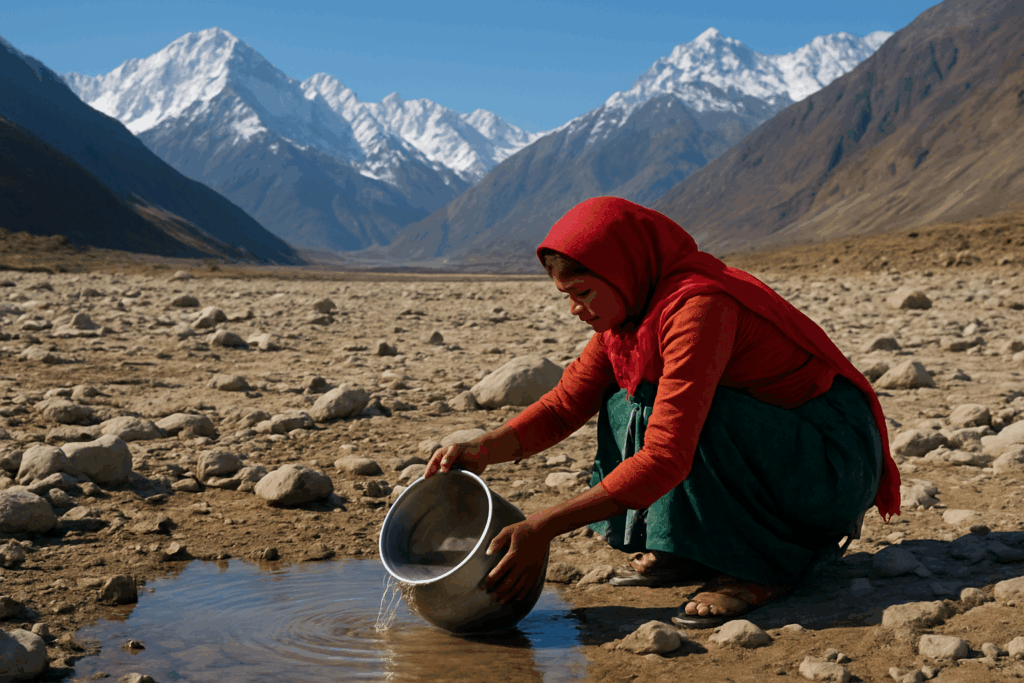
Glaciers on borrowed Time
The most visible sign of the Himalayan Water Security Crisis is the rapid retreat of its glaciers. These icy giants are the primary source of many Himalayan rivers, acting as natural reservoirs that release water during dry seasons. But they’re shrinking at an alarming rate. Scientists predict that many smaller glaciers could disappear entirely by the end of this century.
Picture a colossal ice cube that has been melting relentlessly for decades. That’s essentially what’s happening to the Himalayan glaciers. This isn’t just a concern for distant mountain communities; it directly impacts the agricultural heartlands downstream. Without the steady supply of glacial meltwater, rivers will become entirely dependent on monsoon rains, leading to feast-or-famine cycles of floods and droughts.
Why are Glaciers Melting so Fast?
The main culprit is climate change. Rising global temperatures are having a disproportionate impact on high-altitude regions. Soot and dust from pollution, carried by winds, settle on the ice, making it darker and increasing its absorption of sunlight, thus accelerating melting. It’s a vicious cycle where pollution intensifies the very problem it creates.
- Global Warming: Higher temperatures mean more ice melts and less snow falls to replenish the glaciers.
- Black Carbon: Soot from burning fossil fuels and biomass darkens the ice, making it absorb more heat.
- Changing Weather Patterns: Fewer winter snowfalls mean less accumulation for glaciers to grow.
From Deluge to Drought
For millennia, the South Asian monsoon has been a predictable, life-giving force. Farmers plan their entire year around its arrival. However, in recent decades, the monsoon has become increasingly unpredictable. We’re seeing intense, short bursts of rainfall leading to devastating floods, followed by prolonged dry spells.
This erratic behavior is a direct consequence of the changing climate. Warmer oceans lead to more moisture in the atmosphere, making rainfall more intense when it does occur. Yet, the timing and distribution of these rains are becoming less reliable. It’s like having a faucet that either gushes uncontrollably or trickles maddeningly slowly, never quite providing what you need when you need it.
The Double Whammy for Farmers
Farmers in the Himalayan foothills and the vast plains downstream are caught in a cruel bind. Too much rain at once washes away crops and topsoil, while too little leads to parched fields and failed harvests. This unpredictability threatens food security and the livelihoods of millions.
“The monsoon used to be our clock, our calendar,” says Ramesh, a farmer in Uttar Pradesh. “Now, it’s a gamble. We pray for rain, then pray it doesn’t destroy everything.” His words echo the fears of countless others. This isn’t just an environmental problem; it’s a human crisis unfolding right before our eyes.
- Intense Rainfall: Leads to flash floods, soil erosion, and damage to infrastructure.
- Prolonged Dry Spells: Causes crop failures, water scarcity, and increased demand on groundwater.
- Shifting Seasons: The monsoon’s arrival and departure are becoming less consistent, disrupting traditional farming cycles.
Overexploited Aquifers
While glaciers melt and monsoons play hide-and-seek, another critical water source is being depleted beneath our feet: groundwater. Aquifers, natural underground reservoirs, have been heavily relied upon to compensate for surface water shortages. However, this reliance has turned into overexploitation.
In many parts of the Indo-Gangetic plain, groundwater is being extracted at an unsustainable rate, far exceeding the rate at which it can be replenished. It’s like withdrawing money from a bank account without ever making a deposit. Eventually, the account will run dry. The widespread use of borewells for agriculture and urban consumption has created an invisible crisis, often out of sight and out of mind until the wells go dry.
The Sinking Reality
As water tables drop, the cost of pumping water increases, making agriculture more expensive and pushing marginal farmers into deeper debt. In some areas, the land itself is sinking, a phenomenon known as land subsidence, due to the removal of vast amounts of underground water. This silent thief is stealing the very foundation of life in these regions.
“We used to hit water at 50 feet,” recalls Sunita, a resident of a small town in Uttarakhand. “Now, some people are drilling past 300 feet, and still, nothing. What will happen when there’s no water left at all?” Her question hangs heavy in the air, a stark reminder of the urgency of the Himalayan Water Security Crisis.
A Crisis Beyond the Mountains
The impacts of the Himalayan Water Security Crisis aren’t confined to the mountains. They cascade downstream, affecting megacities, agricultural powerhouses, and entire nations. The Indus, Ganges, and Brahmaputra river basins support over 1.5 billion people. Any disruption to their water supply has monumental consequences.
Consider the densely populated plains of northern India and Bangladesh. Their agricultural productivity is entirely dependent on these rivers. Reduced water availability leads to:
- Food Insecurity: Less water means less food, threatening malnutrition and hunger.
- Economic Instability: Agriculture is a major employer; water scarcity devastates livelihoods.
- Migration: People may be forced to leave their homes in search of water and opportunities.
- Geopolitical Tensions: Competition for dwindling water resources could fuel conflicts between nations.
It’s a terrifying domino effect where a melting glacier in the distant mountains can ultimately lead to a farmer’s ruin thousands of miles away.
What Can We Do? Solutions for a Sustainable Water Future
Addressing the Himalayan Water Security Crisis requires a multi-faceted approach, combining local efforts with international cooperation. It’s not a single silver bullet, but a mosaic of solutions that, when woven together, can create resilience.
Local Innovations and Community Action
Empowering local communities with sustainable water management practices is crucial.
- Rainwater Harvesting: Collecting and storing rainwater for later use, especially in urban areas.
- Traditional Water Systems: Reviving ancient methods of water conservation, like johads (check dams) and baoris (stepwells).
- Efficient Irrigation: Switching to drip irrigation and sprinklers reduces water waste in agriculture.
- Afforestation: Planting trees helps retain soil moisture and recharge groundwater.
- Water-Smart Agriculture: Promoting crop varieties that require less water.
Policy and Regional Cooperation
Governments and international bodies must work together to create effective water policies.
- Transboundary Water Agreements: Nations sharing Himalayan rivers need robust agreements for equitable water sharing.
- Integrated Water Resource Management: A holistic approach that considers all aspects of water use and supply.
- Investing in Infrastructure: Building reservoirs, canals, and water treatment plants to store and distribute water efficiently.
- Research and Monitoring: Continuous study of glaciers, monsoons, and groundwater levels to inform policy.
It’s a monumental challenge, but the solutions exist. What’s needed is the collective will to implement them.
Stories from the Frontline
“My grandmother tells stories of how the river used to roar, overflowing its banks every monsoon,” says Priya, a young activist from Leh. “Now, it’s just a trickle for much of the year. Our traditions, our festivals, they’re all linked to water. What happens when the water is gone?” Her words underscore the deep cultural connection people have with these life-giving rivers.
Nikhil Raj Sharma, founder of Himalayan Geographic, shares his perspective: “The crisis is not just ecological; it’s deeply human. We witness the resilience of communities, but also their growing despair. Education and sustainable practices are our only hope.”
“It’s like a slow-motion catastrophe,” Nikhil Raj Sharma adds, “where every passing year brings us closer to a tipping point. We must act with urgency and compassion.”
Another comment from Nikhil Raj Sharma: “Our mission at Himalayan Geographic is to amplify these voices and connect the dots ; from melting ice to empty taps. The world needs to understand the gravity of this situation.”
The Urgency is Now
The Himalayan Water Security Crisis is not a problem for the distant future; it’s unfolding today. From the shrinking glaciers to the unpredictable monsoons and depleted aquifers, every element points to a need for immediate and sustained action. Our collective future, the well-being of billions, depends on how we respond to this unprecedented challenge.
Related Articles:
We strive to use only images that are either royalty-free, in the public domain, or shared with appropriate permissions. However, if you believe any image on this website has been used without proper credit or violates copyright, please contact us immediately. We will promptly review the content and, if necessary, update the attribution or remove the image without delay. We do not claim ownership of any third-party images unless explicitly stated.