
Discover how Preeti Chauhan, founder of Little Green World, is transforming waste management in the Himalayas through innovative sustainability practices and her revolutionary “7 Rs” philosophy, creating a blueprint for environmental conservation in one of Earth’s most fragile ecosystems.
Picture this: The morning sun paints Himalayan peaks gold while Preeti Chauhan kneels in the dirt, picking through plastic bottles and candy wrappers on the outskirts of Leh. Around her stretches a landscape that has remained untouched for thousands of years ; until now.
“This doesn’t belong here,” she says quietly to the local volunteers helping with the morning cleanup. “None of this belongs here.”
From Corporate Office to Mountain Pass: Preeti Chauhan’s Journey
Preeti didn’t start out as an environmental warrior. She was once a successful civil engineer navigating the corporate world of Mumbai, with prestigious degrees and positions at big-name firms like Louis Berger (now WSP) and IL&FS Infrastructure. On paper, she was living the dream.
But something was missing.
“I was part of building structures meant to last decades,” she told me, looking out at the vast mountain landscape she now calls home. “But was I creating anything that would truly matter in the long run?”
Her first solo trek to Himachal Pradesh in 2017 changed everything. She visited Ladakh for the first time in 2018 and completed the Naropa Fellowship in 2019. There was something about these places ; where the air is thin, life is tough, and the mountains seem to touch the sky ; that grabbed her heart and wouldn’t let go.
“It sounds cheesy, but the mountains were calling me,” she laughs. “And I just couldn’t ignore them anymore.”
So she did what most people would consider crazy. She walked away from her corporate career and moved to Leh ; a city sitting at 11,500 feet where winter temperatures can plunge to -25°C ; to start something new.
“My family thought I’d lost my mind,” she admits with a smile. “Maybe I had. But sometimes the best decisions look like madness at first glance.”
When Traditional Solutions Just Don’t Cut It
Ladakh isn’t just remote ; it’s a world apart. At this altitude, in this climate, normal recycling processes don’t work effectively. Meanwhile, tourism has exploded, with visitor numbers growing tenfold since 2010. All those tourists bring tons of non-biodegradable waste each year.
And here’s the kicker: plastic that might break down in 100-300 years at sea level can last four times longer in Ladakh’s cold, dry climate.
“We couldn’t just copy what works in Mumbai or Delhi,” Preeti explains. “We needed solutions built specifically for this place, these people, these challenges.”
That’s how Little Green World was born ; not just as an environmental consultancy but as Preeti’s vision for a Ladakh where development and conservation walk hand in hand.
The 7 Rs: Not Your Average Environmental Slogan
Most of us know about “Reduce, Reuse, Recycle.” Preeti learned from others and expanded that concept into something much more powerful:
- Refuse: Just say no to stuff you don’t need (especially single-use plastics)
- Reduce: Buy and use less in the first place
- Reuse: Get creative with what you already have
- Repurpose: Turn trash into treasure
- Recycle: Process materials into new products
- Rot: Compost what you can
- Recover: Extract some value from whatever waste remains
“The real power of the 7 Rs is starting with ‘Refuse’ and ‘Reduce,'” says Dr. Sonam Wangchuk, a renowned local environmentalist. “The most sustainable waste is the waste that never exists in the first place.”
This isn’t just talk. These principles have transformed how many Ladakhi communities think about consumption and waste. The results speak for themselves: research shows that this prevention-focused approach can cut waste generation by up to 70% in mountain communities.
Real Solutions for Real People
Preeti isn’t just philosophizing from some mountain retreat. Through Little Green World, she’s created practical initiatives that are changing lives:
Making Tourism Less Trashy
When Preeti started researching and training local hotels and tourism establishments, most were handing out plastic water bottles to every guest. There is a willingness in the local community to reduce waste. Now, many have installed water purification systems and provide reusable bottles instead.
“It’s not a complicated change,” she points out. “But it prevents thousands of plastic bottles from becoming trash every single day.”
Planting Seeds for the Future
“If you want to see lasting change, start with the kids,” Preeti says.
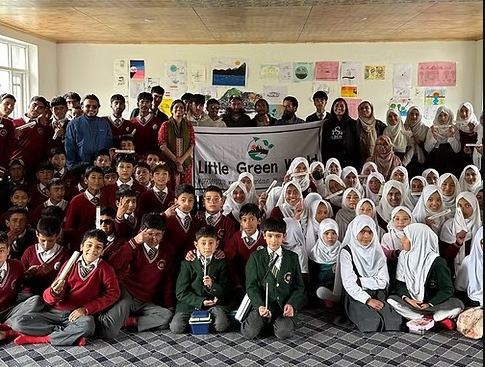
Through her NGO, Navikru Eco Foundation, in partnership with the Wipro Earthian initiative, she’s brought sustainability education to schools across Ladakh. Over 2,000 students in Leh, Kargil, and Zanskar have learned about waste management, biodiversity, and climate resilience through hands-on projects.
“These kids get it instantly,” she tells me, eyes bright with enthusiasm. “They understand what’s at stake in a way many adults still don’t.”
Thinking Global, Acting Local
Plastic that starts in the Himalayas doesn’t stay there. Research shows that up to 20% of plastic pollution in the Indian Ocean comes from Himalayan river systems.
That’s why Preeti’s expertise has earned her a spot as a research partner on a National Geographic project focused on Himalayan plastic waste solutions.
“What we do here matters everywhere,” she explains. “By solving problems at the source, we’re protecting not just Ladakh but oceans thousands of miles away.”
Old Wisdom for New Problems
Ladakh is warming fast ; temperatures have risen 1.6°C over the past century, almost twice the global average. This has brought unpredictable weather, melting glaciers, and disruptions to farming cycles that have sustained communities for generations.
Preeti’s approach combines cutting-edge environmental science with traditional knowledge that Ladakhi people have developed over centuries of living in this extreme environment.
Through her Navikru Eco Foundation, she’s helped revive traditional building techniques that incorporate passive solar heating and natural insulation. She’s also established zero-waste school and community projects to manage waste and created greenhouses that extend Ladakh’s short growing season and reduce dependence on imported food.
“When we grow more local food, we also cut down on packaging waste from imports,” she points out. “It’s a perfect example of how environmental solutions can also be economic and social solutions.”
Breaking the Glass Ceiling at 11,500 Feet
As a woman leading environmental initiatives in a traditional society, Preeti knows firsthand the importance of including women’s voices in climate solutions.
“In Ladakh, women manage water, tend crops, and hold most of the traditional ecological knowledge,” she explains. “But they’re often left out of decisions that directly affect their lives.”
Through her work with the Women Climate Collective 2024, she’s implementing The Women’s Wellness Project in Drass, Kargil. This initiative unfolds in two interconnected phases to sustainably improve menstrual health and empower women economically.
Phase 1
The first phase focuses on raising awareness about sustainable menstrual hygiene practices through culturally sensitive workshops led by trained facilitators. Navikru Eco Foundation has arranged funding for this phase and procured 200 cloth pads and 250 period panties for distribution. The training sessions cover menstrual physiology, the benefits of eco-friendly products, and work to dispel social taboos surrounding menstruation.
The project has already begun successfully, with multiple trainings conducted in the community and local schools, alongside the distribution of cloth pads and period panties to participants. Additionally, a comprehensive needs assessment is underway to understand current menstrual practices, product acceptance, and interest in vocational training, which will inform the design of subsequent phases.
Phase 2
The second phase will build on these insights by selecting 20 women, based on their interest and economic need, for intensive vocational training in cloth pad production. This training will cover sewing techniques, quality control, business management, and cooperative formation, equipping participants with the skills needed to establish small-scale production units or cooperatives. Support will include provision of equipment, assistance in sourcing materials, and access to microfinance, ensuring a strong foundation for sustainable enterprise.
The project will support women in marketing, branding, and connecting with local markets to improve menstrual health and create lasting economic opportunities.
“When women lead environmental projects, they tend to be more inclusive, more collaborative, and more effective,” she says. “That’s not just my opinion ; the research backs it up.”
Mountains Beyond Mountains
While Preeti’s heart belongs to Ladakh, her vision extends far beyond this one region. She’s developed frameworks for sustainable mountain development that are being studied and adapted by communities facing similar challenges across the entire Hindu Kush Himalaya region.
“Mountains are the world’s water towers and biodiversity hotspots,” she explains, passion evident in her voice. “They’re also incredibly vulnerable to climate change. What we’re learning here in Ladakh can help mountain communities worldwide.”
Finding Home in the High Places
As the sun sets behind snow-capped peaks, casting long shadows across the ancient landscape, Preeti reflects on her journey.
“I never planned for this to be my life,” she says quietly. “But now I can’t imagine being anywhere else.”
In the fading light, Ladakh’s beauty takes on an otherworldly quality ; a reminder of what’s at stake in Preeti’s quiet revolution.
“The Himalayas don’t belong to us,” she says with quiet conviction. “We belong to them. And if we listen closely enough, they’ll teach us how to live in balance with the earth.”
As darkness falls, Preeti continues her work ; sorting waste, teaching communities, and building a sustainable future one small action at a time. In this remote corner where mountains touch the sky, she has found her purpose: to be a guardian of the Himalayas, ensuring their majesty endures for generations to come.
Want to learn more about Preeti’s work? Visit Little Green World, Navikru Eco Foundation or follow her on social media Preeti Chauhan