
Explore the hidden world of Himalayas rivers flowing beneath glaciers; silent, powerful waterways that shape ecosystems, sustain communities, and carry ancient secrets beneath the ice.
Have you ever stood atop a glacier, feeling its ancient ice beneath your feet, and wondered what secrets lurk below? The answer might surprise you ; entire Himalayan Rivers systems flowing in darkness, carrying the lifeblood of Asia in channels few human eyes have ever seen.
Last summer, I found myself on the Gangotri Glacier, that strange vibration beneath my boots catching me off guard. It wasn’t just solid ice – it was the subtle pulse of flowing water far below. My guide Tenzing caught my puzzled look and smiled warmly. “The mountain speaks through water,” he said, pointing downward with weathered hands. “Our ancestors always knew the rivers begin their journey in darkness.”
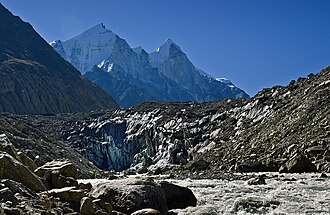
Check out this incredible footage of Gangotri Glacier from above: The source of the Ganges
The Hidden Himalayas Rivers That Feed a Continent
The Himalayas ; our planet’s “Third Pole” ; cradle the largest ice reserves outside the polar regions. But these massive glaciers aren’t simply frozen solid mountains. They’re honeycombed with intricate waterways, flowing rivers, and vast aquifers hidden from human eyes.
These subterranean rivers aren’t merely geological curiosities. They’re the silent engineers of Asia’s water security, directly impacting over 1.9 billion people across ten countries who depend on Himalayan water systems for their very survival.
“What happens beneath the ice ultimately determines what flows from your tap in Delhi, Dhaka, or Islamabad,” explains Dr. Sunita Narain, her eyes lighting up as she shows me glacier maps at the Himalayan Geographic Research Foundation. “These hidden rivers are essentially Earth’s most critical plumbing system.”
For an excellent overview of Himalayan glacier systems and their importance, watch: Melting Glaciers, Growing Lakes: The Himalayan Climate Crisis
Seven Remarkable Subglacial River Systems
1. The Khumbu Underflow (Nepal)
Beneath Mount Everest’s famous Khumbu Icefall lies an intricate network of englacial channels that regulate seasonal flow to Nepal’s river systems. Using ground-penetrating radar, scientists recently mapped over 60km of interconnected waterways that local Sherpa communities had documented in oral histories for centuries.
Over steaming butter tea in a small teahouse, Pemba Sherpa tells me, “My grandfather could predict spring water levels in Namche Bazaar by listening to the ice in winter.” His eyes crinkle with knowing pride. “Scientists now use million-dollar equipment to tell us what our ancestors knew from observation.”
See the dramatic Khumbu Icefall and learn about its dynamics: Treacherous crevasses of Khumbu icefall
2. The Siachen Aquifer System (India/Pakistan)
Below the world’s highest battlefield sits one of Asia’s most remarkable hidden hydrological features ; a massive subglacial lake and river system feeding both the Indus and Nubra rivers. This underground reservoir acts as a natural regulator, storing meltwater during warm periods and releasing it during drier months.
Hydrologist Dr. Ahmed Khan explains over a crackling satellite phone call from his field station: “The Siachen system essentially functions as nature’s perfect dam. Without it, downstream communities would face devastating floods followed by catastrophic droughts.”
Get a rare glimpse of the Siachen Glacier region: Siachen: The World’s Highest Battlefield
3. Zanskar’s Ghost Rivers (India)
The remote Zanskar region features a phenomenon locals call “ghost rivers” ; subglacial streams that mysteriously appear and disappear seasonally. These waterways flow through intricate cave systems beneath the ice, emerging as springs miles from their origin points.
I meet Stanzin Dorjay as he carefully adjusts irrigation channels around his barley field. “My village relies on a spring that only flows from April to October,” he explains, wiping sweat from his brow. “Our ancestors built irrigation channels following its rhythm. Modern scientists recently discovered the water actually travels 17km beneath the Drang-Drung glacier before reaching us.”
Experience the stunning beauty of Zanskar in winter: Winter Life at Zanskar’s Remote SHADAY Village
4. Langtang’s Moulin Network (Nepal)
The Langtang glacier contains one of the most complex moulin systems ever documented – vertical shafts that allow surface meltwater to plunge deep into the glacier. These natural drainpipes create an ever-shifting three-dimensional maze of waterways that respond dynamically to seasonal changes.
Recent expeditions using robotic cameras revealed stunning ice caverns and flowing rivers up to 200 meters below the surface. “It’s like discovering an entirely new ecosystem,” notes glaciologist Maya Sherpa, her face illuminated by laptop screens displaying the latest footage. “The water chemistry and flow patterns influence everything from downstream fish migration to crop cycles in villages 100km away.”
See amazing footage of LANGTANG VALLEY TREK IN NEPAL
Sali Trekking
5. Bhutan’s Sacred Aquifers (Bhutan)
Beneath Bhutan’s Gangkhar Puensum – the world’s highest unclimbed mountain – lies a system of pressurized aquifers that local Buddhist traditions have venerated for centuries as the home of water deities. Modern hydrology has confirmed these subglacial reservoirs provide critical drought resistance to the region.
During the catastrophic 2015 drought, villages connected to these systems maintained water access while others suffered severe shortages. In a small monastery library, a monk carefully shows me yellowed texts – monastery records dating back 400 years that documented these drought-resistant properties long before modern science.
6. Kailash Underground River (Tibet/China)
Mount Kailash, sacred to four religions, conceals what might be Asia’s longest continuous subglacial river – a 112km waterway that flows entirely beneath ice and rock. This remarkable system was long documented in Tibetan texts but only confirmed by Chinese scientists in 2019 using seismic imaging technology.
“What makes this system unique is its thermal properties,” explains Dr. Li Wei, gesturing excitedly at thermal imaging displays in his Beijing laboratory. “The water maintains a constant temperature of 4°C regardless of surface conditions, creating unique ecological niches at its emergence points.”
Journey to mystical Mount Kailash: Mt.Kailash Pilgrimage, Visit the Center of the World
7. Karakoram Pressure Channels (Pakistan)
The Karakoram Range features one of Earth’s most unusual hydrological systems – pressurized water channels that actually flow uphill in some sections due to the immense weight of overlying ice. Local knowledge of these counterintuitive flows informed water management practices for generations.
Ibrahim Karim welcomes me into his modest home in Hushe Valley, serving sweet tea as he explains: “Our village discovered these unusual properties centuries ago. We built our irrigation systems to account for water that appears to defy gravity during certain seasons. Scientists now explain it’s due to glacial pressure, but we simply followed what the mountain taught us.”
Experience the majesty of the Karakoram Range: CALL OF THE KARAKORAM
Ancient Knowledge Meets Modern Science
What’s particularly fascinating about these hidden river systems is how traditional knowledge often anticipated scientific discoveries by centuries.
In Ladakh, the artificial glacier movement pioneered by engineer Sonam Wangchuk builds on traditional understanding of how underground ice formations regulate water flow. His famous “ice stupas” – conical ice towers that store winter water for spring irrigation – mirror natural processes occurring beneath glaciers.
“Indigenous communities didn’t need satellite imagery to understand these systems,” notes anthropologist Dr. Kavita Sharma as we trek between villages in Spiti Valley. “They observed downstream effects and developed sophisticated cultural practices around them. The ‘water calendar’ of Spiti Valley precisely tracks underground meltwater fluctuations through changes in spring flow rates.”
Watch Sonam Wangchuk explain his revolutionary ice stupa project: Ice Stupas: An Ingenious Solution to Water Scarcity
This traditional knowledge is increasingly valuable as climate change disrupts historical patterns. When the Chaturangi glacier’s subglacial drainage system suddenly shifted in 2018, causing water shortages in downstream villages, local elders consulted ancient records of similar events from 1872.
“The scientific equipment was telling us this was unprecedented,” admits glaciologist Dr. Robert Chen, shaking his head. “But village records described identical symptoms and suggested drainage would likely reestablish along ancient secondary channels within three weeks. They were exactly right.”
Climate Crisis and Hidden Waters
These subterranean systems now face unprecedented threats. Rising temperatures aren’t just melting surface ice ; they’re reorganizing the complex plumbing beneath.
Accelerated melting creates more moulins (vertical drainage shafts), allowing more water to enter subglacial systems. This initially increases flow but eventually leads to structural collapse as ice support diminishes.
“We’re seeing catastrophic reorganization of drainage networks that have remained stable for centuries,” warns Dr. Priya Singh as she shows me alarming data visualizations at the International Centre for Integrated Mountain Development. “This doesn’t just affect water quantity ; it changes water quality, timing, and temperature, with cascading effects throughout ecosystems.”
Learn about climate change impacts on Himalayan glaciers: Climate Crisis in the Himalayas
The consequences extend far beyond the mountains. When the Khumbu Underground River system experienced a major rerouting in 2022, drinking water supplies in villages 60km downstream suddenly contained different mineral profiles. Crops failed as irrigation water chemistry changed without warning.
Guardians of the Hidden Rivers
Amid these growing threats, innovative partnerships between scientists and local communities offer hope. In Nepal’s Khumbu region, Sherpa communities maintain a network of traditional “ice listeners” who document subtle changes in glacial acoustics that often precede major hydrological shifts.
These observations are now systematically recorded and shared with glaciologists, creating an early warning system for subglacial drainage changes that outperforms many high-tech monitoring solutions.
Similarly, in India’s Spiti Valley, the 1,000-year-old tradition of water committees (called churpon) has evolved to incorporate scientific data. I watch, fascinated, as village water managers use tablets to record traditional observations alongside satellite imagery, creating uniquely comprehensive datasets.
“The most successful conservation approaches combine advanced technology with generational knowledge,” explains Tashi Namgyal, who serves as both a traditional churpon and a trained hydrological technician. His weathered hands swipe deftly across a tablet screen displaying satellite imagery. “Neither approach alone tells the complete story.”
Preserving Waters Seen and Unseen
As these hidden river systems face unprecedented challenges, their protection requires both scientific understanding and cultural reverence. The ancient glaciers hold not just water but wisdom ; accumulated knowledge encoded in traditions, stories, and practices that modern science is only beginning to fully appreciate.
“These aren’t just water sources ; they’re teachers,” reflects Karma Samten, a Buddhist monk and environmental activist, as we watch sunset paint Himalayan peaks golden. “For centuries, they’ve taught us about interdependence, patience, and humility. Now they’re teaching us about change and adaptation.”
Perhaps the most important lesson these hidden rivers offer is one of interconnection. What happens beneath remote Himalayan glaciers ultimately affects life and livelihoods across Asia. The waters that begin their journey in darkness eventually emerge to nurture the continent’s most populous regions.
“Understanding these systems isn’t just about scientific curiosity,” emphasizes Dr. Arun Kumar as we conclude our interview at the Himalayan Geographic Research Foundation. “It’s about securing water futures for billions of people in an increasingly uncertain climate.”
Watch this powerful documentary on water security in Asia: Asia’s Water Tower: The Himalayan Watershed
As we face these challenges, the silent rivers beneath the ice remind us that some of Earth’s most vital systems operate beyond our daily perception ; flowing quietly, steadfastly, beneath the surface of our awareness yet fundamentally shaping our world.
Have you ever considered how water systems you’ve never seen might be affecting your daily life? Share your thoughts in the comments below!
“We strive to use only images that are either royalty-free, in the public domain, or shared with appropriate permissions. However, if you believe any image on this website has been used without proper credit or violates copyright, please contact us immediately. We will promptly review the content and, if necessary, update the attribution or remove the image without delay. We do not claim ownership of any third-party images unless explicitly stated.”
